Jet Charter Flying Cloud
Jet charter Flying Cloud means flying into a reliever airport with a 5,001 ft runway. Flying Cloud sits at 906 ft elevation and is 1,285 miles to the Strip. Book with a broker who knows the field.
- KFCM · FCMairport codes
- 906 ftfield elevation
- 5,001 ftlongest runway
- 14 mito Downtown Minneapolis
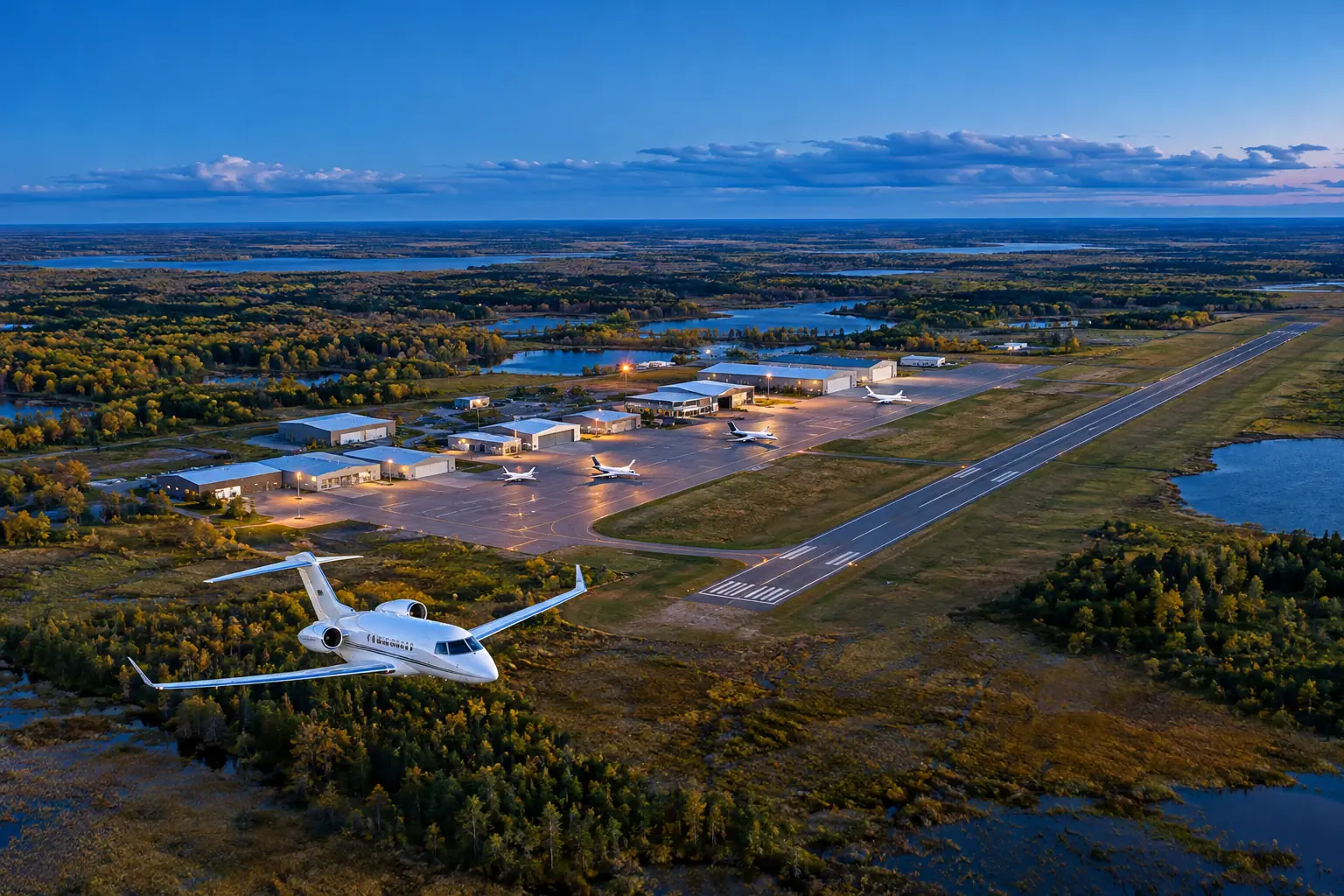
Jet charter Flying Cloud starts with the field itself: FCM has one paved runway of 5,001 ft, an elevation of 906 ft, and a single FBO, Thunderbird Aviation. That layout keeps operations simple, but it also means your aircraft choice has to match the runway and the season. The 5,001 ft runway handles most light and midsize jets at Flying Cloud. If your trip calls for a larger cabin, then the broker should compare FCM against other Twin Cities airports before quoting.
The airport sits southwest of downtown Minneapolis near Eden Prairie, which makes it a practical arrival point for business travelers headed to the western suburbs and for leisure trips to the lakes. Flying Cloud is a reliever airport that keeps you out of the MSP terminal crowds. For a party of four to eight, a light or midsize jet usually fits the mission. For a larger group or a longer leg, the 5,001 ft runway at 906 ft elevation may limit payload on hot days, so plan the fuel stop or the aircraft swap in advance.
Brokers arrange the flight; the operator flies it. Under DOT Part 295, a charter broker acts as your agent and does not hold operational control. The flight itself is flown by an operator holding FAA Part 135 authority, and that operator is responsible for crew, maintenance and dispatch. Ask for the operator's certificate number and insurance limits before you sign. For international legs, CBP clearance and passenger documentation are handled through the operator, and TSA screening rules apply where the aircraft and itinerary require them.
Flying Cloud runway length
Flying Cloud has a longest runway of 5,001 ft at an elevation of 906 ft, which is enough for many light and midsize jets but not every heavy or long-range type. The single 5,001 ft runway at FCM sets the practical limit on aircraft size. When the temperature climbs, density altitude rises and takeoff distance grows, so a midsize jet that performs well in April may need a different plan in July. If your itinerary requires a larger cabin, then the broker should price the trip out of another Twin Cities field with a longer runway before you commit. Runway condition, obstacles and current notams are checked by the operator on the day of flight.
| Runway | Lgth | Width | Surface |
|---|---|---|---|
| 10R/28L | 5,001 ft | 100 ft | Asphalt |
| 10L/28R | 3,901 ft | 75 ft | Asphalt |
FBO and ground handling at Flying Cloud
Thunderbird Aviation is the FBO on the field at Flying Cloud, and it handles the ground side of your arrival. Thunderbird Aviation is the single FBO serving jet charter Flying Cloud arrivals and departures. Ground handling, fueling and passenger pickup are coordinated through that one operation, which keeps the logistics tight but also means schedules can bunch up on busy days.
Because there is one FBO, your broker should confirm handling and any after-hours fees when the quote is built, not after the tail number is assigned. If your flight lands outside normal staffed hours, then expect an after-hours callout charge to appear on the final invoice. Ask for the line items in writing so the estimate you compare is the estimate you pay.
Trips that fit jet charter Flying Cloud
- Business travel to the western Minneapolis suburbs and Eden Prairie offices, avoiding the MSP terminal.
- Lakes-country weekends and family trips where a light or midsize jet matches the 5,001 ft runway.
- One-way and empty leg flights when a repositioning aircraft is already heading your direction.
- Groups of four to eight flying a route under roughly 1,300 miles, such as the 1,285 miles to the Strip.
| Class | Runway need, typical | Here |
|---|---|---|
| Turboprop | 3,300 ft+ | Fits |
| Light jet | 4,000 ft+ | Fits |
| Midsize jet | 5,000 ft+ | Fits |
| Super-midsize jet | 5,200 ft+ | Weight-limited |
| Heavy jet | 5,600 ft+ | Weight-limited |
Weather and density altitude by season
July is the hottest month at Flying Cloud with an average high of 83F and a July density altitude of 2,700 ft. Density altitude at FCM peaks at 3,300 ft on a 115F day, which changes takeoff performance. In practice, that means a light jet loaded for a long leg may need a fuel stop or a lighter passenger count on the hottest afternoons. Summer also brings the most convective weather, so build slack into tight connections.
Winter runs the other way. January averages a high of 25F with a density altitude near -1,100 ft, which helps performance but brings deicing and snow-removal delays. January density altitude at Flying Cloud drops to about -1,100 ft, so cold-weather takeoffs are rarely the constraint. Spring and fall are the swing months, with wet days peaking at 12 in May. If your trip is time-critical, then a morning departure usually beats an afternoon slot in summer.
| Month | Avg high | Wet days | Density altitude |
|---|---|---|---|
| Jan | 25°F | 5 | -1,100 ft |
| Feb | 28°F | 6 | -900 ft |
| Mar | 43°F | 7 | 100 ft |
| Apr | 54°F | 11 | 800 ft |
| May | 69°F | 12 | 1,800 ft |
| Jun | 80°F | 11 | 2,500 ft |
| Jul | 83°F | 9 | 2,700 ft |
| Aug | 80°F | 11 | 2,500 ft |
| Sep | 74°F | 10 | 2,100 ft |
| Oct | 58°F | 9 | 1,100 ft |
| Nov | 43°F | 8 | 100 ft |
| Dec | 30°F | 8 | -800 ft |
Getting to and from the airport
Flying Cloud sits southwest of downtown Minneapolis, close to Eden Prairie and the Highway 212 and I-494 corridors. The airport is a short drive from the western suburbs, which saves the MSP terminal walk and the curb wait. Most passengers arrive by car or rideshare, and the FBO coordinates drop-off and pickup with the crew. If you are connecting to a meeting in downtown Minneapolis, then allow for rush-hour traffic on I-494 and I-35W before you set a pickup time.
Private jet routes via Flying Cloud
Across these 6 private jet routes, distance runs 299 to 1,333 nautical miles; one-way light jet estimates span $4,000 to $25,000.

Airport FAQ
What runway length does jet charter Flying Cloud use?
Flying Cloud has a longest runway of 5,001 ft at an elevation of 906 ft. That length suits most light and midsize jets but can limit larger cabins on hot days. If your aircraft needs more runway, then the broker should compare FCM with Saint Paul Downtown Holman Field, which has 6,491 ft, or Minneapolis–Saint Paul International, which has 11,006 ft.
How hot does it get at Flying Cloud in summer?
July averages a high of 83F, with a July density altitude of 2,700 ft. On a 115F day, density altitude at FCM can reach 3,300 ft, which raises takeoff distance. If you are flying a heavy load on a hot afternoon, then plan a fuel stop or a lighter passenger count so the aircraft stays within performance limits.
Which FBO handles jets at Flying Cloud?
Thunderbird Aviation is the FBO on the field. It handles fueling, ground handling and passenger pickup for arrivals and departures. Because there is one FBO, ask your broker to confirm handling fees and after-hours charges in the quote. If your flight lands late, then an after-hours callout fee will likely apply.
How far is Flying Cloud from downtown Minneapolis?
The airport is southwest of downtown Minneapolis, near Eden Prairie and the Highway 212 and I-494 corridors. That puts it closer to western suburban offices than MSP. If you are heading downtown, then allow extra time for rush hour on I-494 and I-35W before you schedule a car.
Who is responsible for the flight when I book jet charter Flying Cloud?
The flight is flown by an operator holding FAA Part 135 authority, and that operator holds operational control. Your broker acts as your agent under DOT Part 295 and does not operate the aircraft. If you are crossing a border, then the operator handles CBP clearance, and TSA rules apply where the itinerary requires screening.
What does a jet charter Flying Cloud trip cost?
Prices are estimates and vary by aircraft, date and one-way or round trip. A light jet typically costs less per hour than a midsize or heavy jet, and empty leg flights can be priced lower when an aircraft is repositioning. If your dates are flexible, then ask the broker to check empty legs before you book a standard charter.