Jet charter aircraft Minneapolis
We arrange jet charter aircraft Minneapolis flights through FAA Part 135 operators. Light jets run $3,800 to $5,800 per hour. Chicago is a 1h 02m leg.
- Home
- Aircraft

Minneapolis sits closer to the middle of the country than most people realize, and that shapes what flies here. A light jet covers Chicago in about an hour or Dallas in two, so the short and mid-range legs that fill most Twin Cities schedules don't demand a big cabin. The heavy iron earns its rate on the long westbound and international runs, where range and baggage space start to matter more than hourly cost.
Every aircraft below is an example of what operators position for Twin Cities departures, not a fleet we own. We are a broker: flights are operated by FAA Part 135 certificated companies that hold operational control, and we act as your agent under DOT Part 295. That distinction matters when you compare quotes, because the operator flying the trip sets the final price and crew.

Turboprop
Turboprops hold the short Twin Cities routes where a jet is more aircraft than the trip needs. At 290 to 350 knots and $2,200 to $3,500 per hour, they suit Duluth runs, Rochester shuttles and Des Moines legs where a jet's climb and descent eat the advantage. They also use shorter runways and burn less fuel, which shows up in the quote. Cabin noise is higher than a jet, and cruise altitude is lower.
Pilatus PC-12 NGX
- 6 seats
- 290 kt cruise
- 1,800 nm range
Six passengers, 1,800 nautical miles and a single engine that keeps costs down. At 290 knots with 40 cu ft of baggage, it suits small groups on regional legs. The cabin is 4 ft 10 in tall and 16 ft 11 in long, so it is a sit-down cabin rather than a stand-up one. Operators run it into smaller Minnesota fields that jets skip.
Daher TBM 960
- 6 seats
- 330 kt cruise
- 1,730 nm range
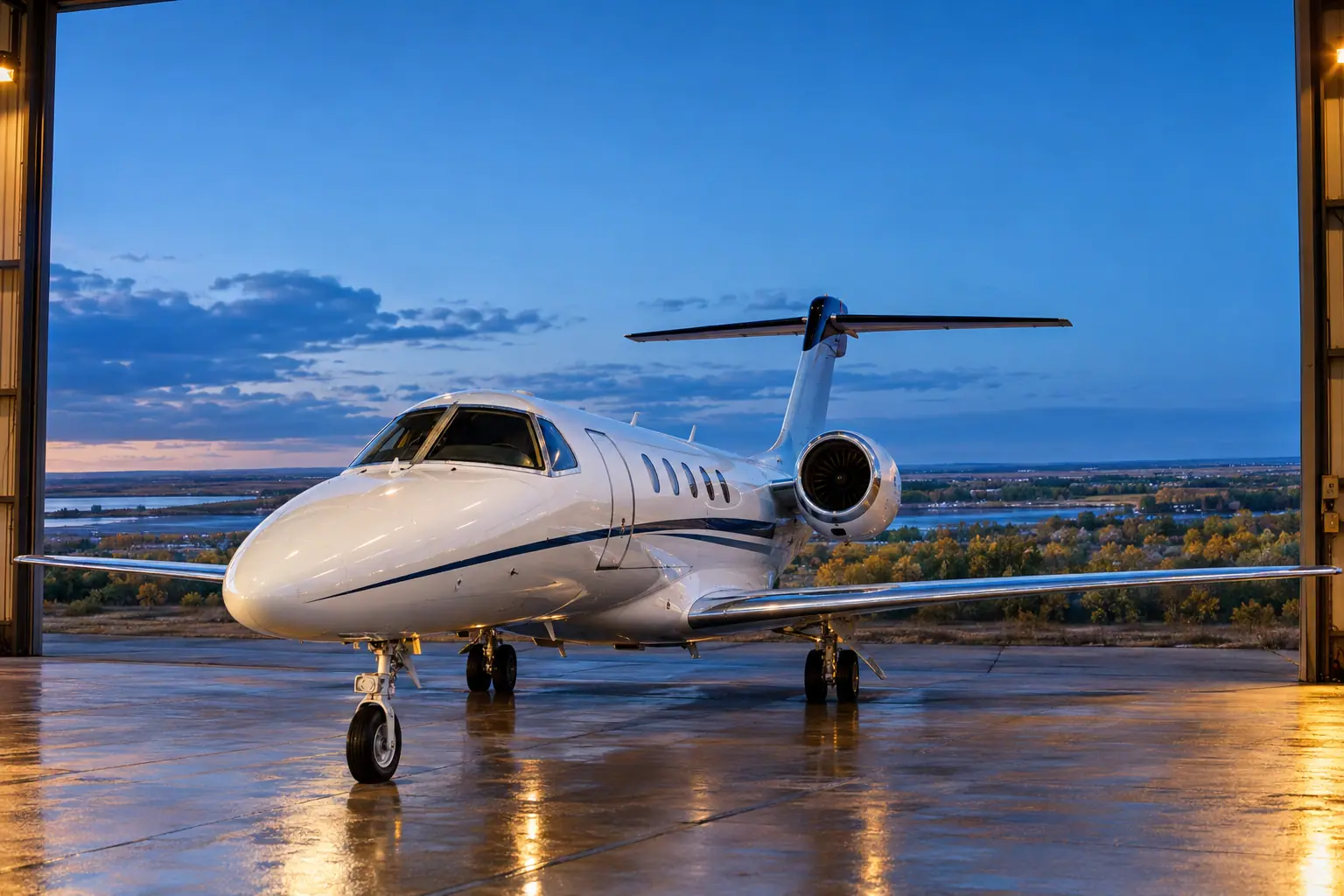
Light jet
Light jets cover the Chicago, Dallas and Denver legs that make up most Minneapolis charter demand. At $3,800 to $5,800 per hour and 430 knots, they carry 4 to 7 passengers with modest baggage. Range of roughly 1,400 nautical miles handles most of the eastern U.S. and Canada. Cabin height around 4 ft 9 in means most adults stand stooped or not at all. For two-hour flights, that is a fair trade for the lower rate.
Cessna Citation CJ4 Gen2
- 7 seats
- 451 kt cruise
- 2,165 nm range
Seven seats, 451 knots and 2,165 nautical miles of range. This is the light jet most Twin Cities travelers end up booking. Baggage runs 71 cu ft and the cabin is 17 ft 4 in long. Denver, Dallas and Atlanta all work nonstop with a full cabin. It cruises higher and quieter than the turboprops at a modest step up in hourly rate.
Embraer Phenom 300E
- 7 seats
- 464 kt cruise
- 2,010 nm range
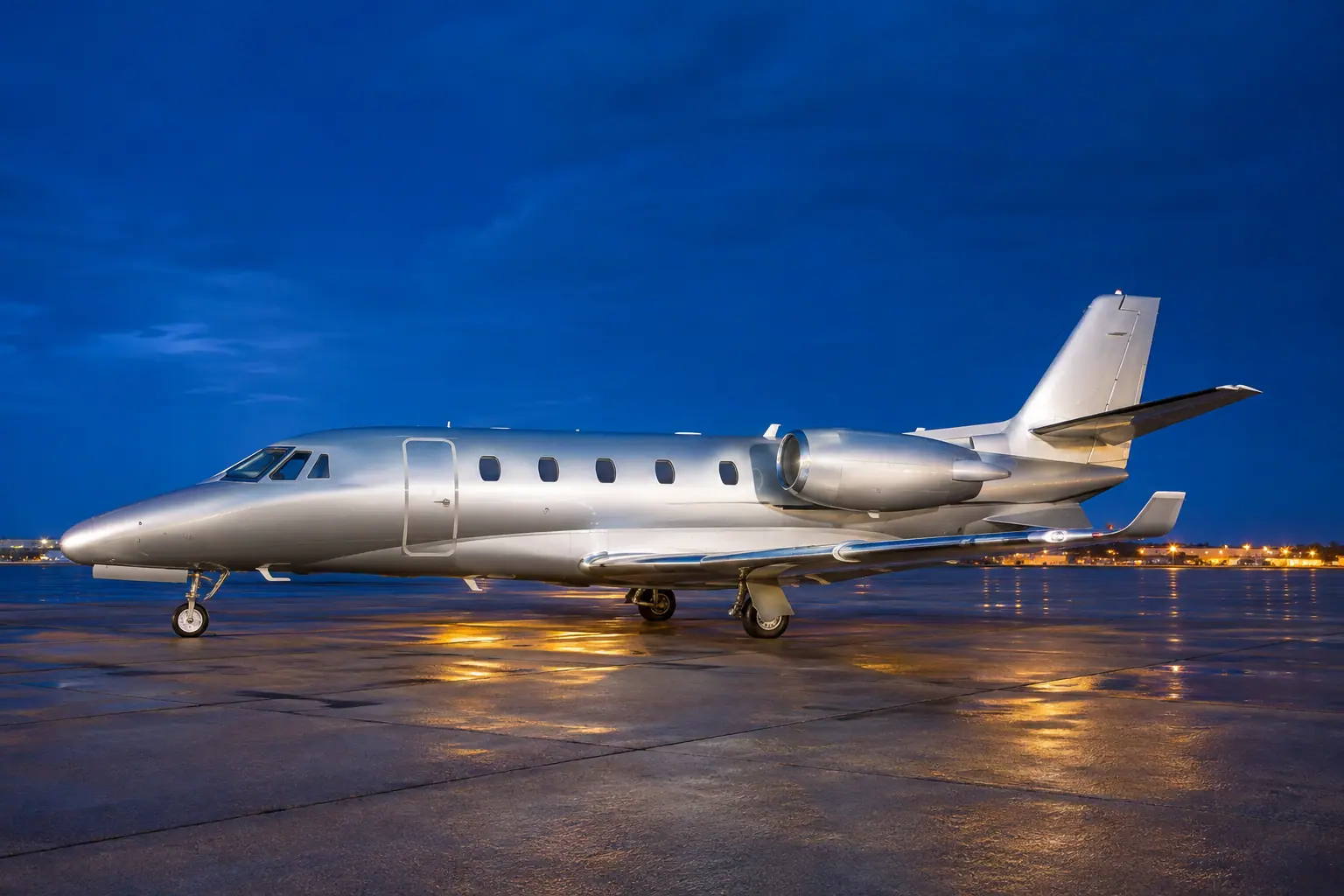
Midsize jet
Midsize jets add stand-up headroom and real baggage space for Minneapolis nonstops. At $5,200 to $7,800 per hour, they cruise near 440 knots with 7 to 9 seats and cabins about 5 ft 8 in tall. Range near 2,100 nautical miles covers the coasts and most of the Mountain West. If your group checks ski bags or golf clubs, this is the class where the 90 cu ft holds stop being a planning problem.
Cessna Citation XLS+
- 8 seats
- 441 kt cruise
- 2,100 nm range
Ninety cubic feet of baggage is the reason groups pick this one. Eight seats, 441 knots and 2,100 nautical miles of range, with a cabin 5 ft 8 in tall and 18 ft 6 in long. For a family ski trip or a foursome with golf clubs, that bin space means no shipping gear ahead. It covers the eastern U.S. and most of the Mountain West nonstop from Minneapolis.
Cessna Citation Latitude
- 9 seats
- 446 kt cruise
- 2,700 nm range

Super-midsize jet
Super-midsize aircraft handle the long transcontinental routes out of Minneapolis without a fuel stop. At $7,200 to $10,000 per hour and up to 527 knots, they carry 8 to 10 passengers with 3,200-plus nautical miles of range. Los Angeles, San Francisco and Seattle all work nonstop with a full cabin. Cabins near 6 ft 3 in tall and 154 cu ft of baggage make them the practical pick for a week-long trip.
Cessna Citation X+
- 9 seats
- 527 kt cruise
- 3,460 nm range
At 527 knots, this is the fastest aircraft on this list, and it shows on long legs. Nine seats, 3,460 nautical miles of range and 82 cu ft of baggage, with a cabin 5 ft 8 in tall and 25 ft 2 in long. On a Minneapolis to Los Angeles run the speed advantage is real. If schedule is the constraint rather than cabin height, this is the one to ask about.
Bombardier Challenger 350
- 10 seats
- 470 kt cruise
- 3,200 nm range
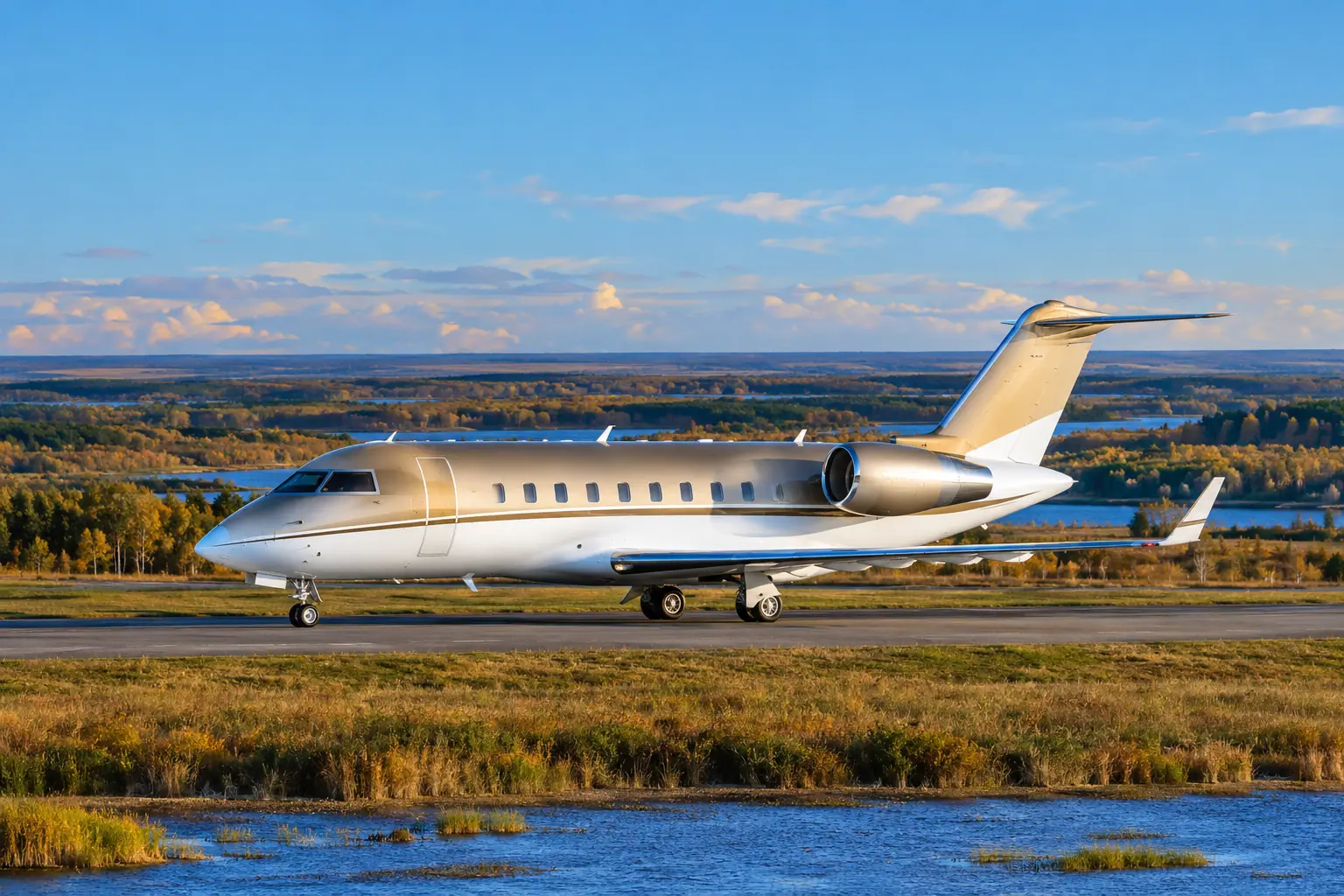
Heavy jet
Heavy jets fly the international legs where Minneapolis range matters most. At $9,500 to $14,500 per hour, they seat 10 to 14 with cabins over 6 ft and up to 4,750 nautical miles of range. Nassau, Cabo San Lucas and Turks and Caicos are all nonstop, though international legs add CBP clearance on the return. For a full team plus cargo, this is the class that clears the bin.
Dassault Falcon 900LX
- 12 seats
- 459 kt cruise
- 4,750 nm range
The longest legs on this list: 4,750 nautical miles and a cabin 33 ft 2 in long. Twelve seats, 459 knots and 127 cu ft of baggage. Minneapolis to Turks and Caicos at 1,727 nautical miles is well inside its range with room to spare. Three engines mean it can take routes over water that a twin might route around, which matters on Caribbean legs.
Gulfstream G450
- 14 seats
- 476 kt cruise
- 4,350 nm range
Choosing a jet charter aircraft
Match the aircraft to the leg length and headcount, not to the brochure. A Minneapolis to Chicago run is 299 nautical miles and a light jet does it in 1h 02m for $4,000 to $6,000. Put a heavy jet on that leg and you pay roughly double for cabin space nobody uses in an hour. Work the trip length first, then the passenger count, then the baggage.
Then check the airport, because the field constrains the aircraft. Minneapolis–Saint Paul International has an 11,006 ft runway and no based FBOs for charter, while Flying Cloud and Anoka County-Blaine both run about 5,000 ft with an FBO on site. Saint Paul Downtown Holman Field has 6,491 ft and Signature Aviation. Summer density altitude reaches 3,300 ft at the smaller fields, which can limit a heavy jet's payload on a hot afternoon. Flying Cloud sits closest to downtown at 1,285 miles to the strip. Ask which airport your operator prefers before you accept a quote.
Get the quote in writing with the operator's name on it. As a broker we act as your agent under DOT Part 295 and the operator holds operational control, so the certificate number and tail number should appear on your confirmation. For international legs, confirm who handles CBP clearance and where you clear back into the U.S. If a price looks low for the route, ask what the empty leg positioning adds.
Questions
What does jet charter aircraft in Minneapolis cost per hour?
Rates run $2,200 to $3,500 per hour for turboprops, $3,800 to $5,800 for light jets, $5,200 to $7,800 for midsize, $7,200 to $10,000 for super-midsize and $9,500 to $14,500 for heavy jets. These are estimates from operator quotes and exclude positioning, crew overnight and international fees. A short Minneapolis to Chicago leg prices closer to $4,000 to $6,000 total in a light jet.
Which Minneapolis airport will my jet charter use?
Most light and midsize flights use Flying Cloud or Anoka County-Blaine, both with runways near 5,000 ft and an FBO on site. Saint Paul Downtown Holman Field has 6,491 ft and Signature Aviation. Minneapolis–Saint Paul International has the longest runway at 11,006 ft but no based FBOs for charter, so it is less common for private departures. The operator picks the field based on aircraft weight and your destination.
How long is a light jet flight from Minneapolis to New York?
About 2h 25m over 869 nautical miles, priced roughly $9,000 to $14,000 in a light jet. That is faster than the airline block time and lands you at a general aviation field rather than a commercial terminal. Eastbound winds help; the return leg can run longer. If you need to work in the air, a midsize with a taller cabin is worth the step up.
Can a light jet fly nonstop from Minneapolis to Los Angeles?
Yes, at 1,333 nautical miles and about 4h 18m, which is inside the 1,400 nautical mile range typical of the class. Expect roughly $16,500 to $25,000. A super-midsize or heavy jet gives more cabin room and baggage for the same route. On hot summer afternoons, density altitude at the smaller fields can trim payload, so confirm bags with the operator.
Do I need to clear customs on a charter from Minneapolis to the Caribbean?
On the return, yes. CBP clearance is required when you re-enter the U.S., and the operator files the eAPIS manifest before departure. Cabo San Lucas is 1,541 nautical miles from Minneapolis and Nassau is 1,414, both inside heavy jet range. Turks and Caicos at 1,727 nautical miles needs a long-range aircraft. Confirm which airport you clear through on the way home.
Who is responsible for the flight if something goes wrong?
The operator, not the broker. Flights are flown by FAA Part 135 certificated companies that hold operational control, maintain the aircraft and employ the crew. We act as your agent under DOT Part 295 to source and compare quotes. That is why your confirmation should name the operator and the tail number. Read the operator's certificate before you sign anything.
Does an empty leg make a Minneapolis charter cheaper?
Sometimes. An empty leg is a repositioning flight the operator would otherwise fly with no passengers, so the price drops when your route matches. Availability is unpredictable and the schedule can move or cancel. If your dates are firm, a standard charter is the safer booking. If they are flexible, ask us to watch for empty legs on your route.